HRMS Full Cycle: How Emmato Connects Recruitment, Employees, Payroll, Performance & Workforce Intelligence
From Recruitment to Retirement: One Connected HRMS for the Complete Employee Lifecycle
 Satender SharmaFounder & Global CEO Sep 8, 202613 min reademmato
For years, HR teams have been surrounded by spreadsheets, emails, attendance registers, payroll files, approval messages, and disconnected software.
A candidate applies for a job on one platform. Their information is copied into another system after selection. Attendance is managed somewhere else. Payroll depends on another application. Performance reviews happen through spreadsheets. Timesheets sit in a separate tool.
The employee may be the same person—but the data is fragmented across multiple systems.
This creates a simple but expensive problem:
HR knows the employee. Finance knows the salary. Managers know the work. Recruitment knows the candidate. But no one sees the complete picture.
This is where modern Human Resource Management Systems (HRMS) are changing the way organizations manage their workforce.
An HRMS is no longer simply a digital employee database. It is becoming a connected platform that manages recruitment, onboarding, attendance, payroll, performance, productivity, analytics, and workforce development.
Organizations looking to modernize their wider technology environment can also explore NexGen's digital engineering capabilities, where AI-first product engineering, modernization, cloud-native development, and enterprise technology come together.
Emmato is built around this same idea of connected operations.
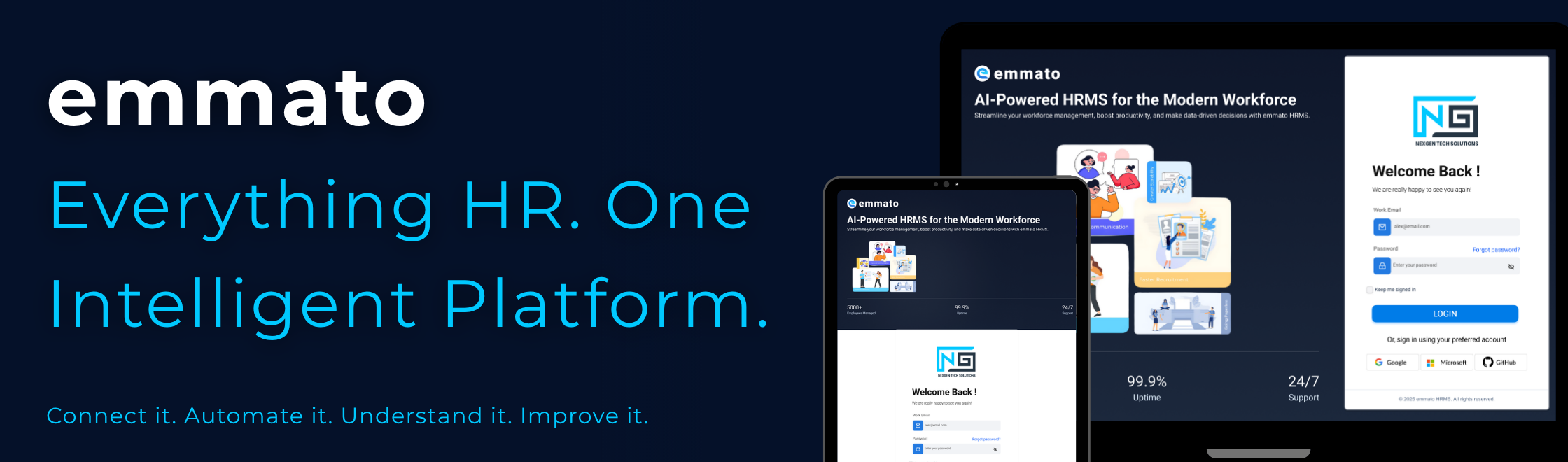
The platform brings HR, payroll, recruitment, performance and employee engagement together in one AI-powered environment.
The result is a simple vision:
Recruit people. Manage work. Understand performance. Automate HR. Grow the workforce—all from one intelligent HRMS.
What Is the Full HRMS Cycle?
The HRMS full cycle refers to the complete journey of an employee inside an organization.
It begins before an employee joins and continues throughout their employment.
A modern HRMS lifecycle can include:
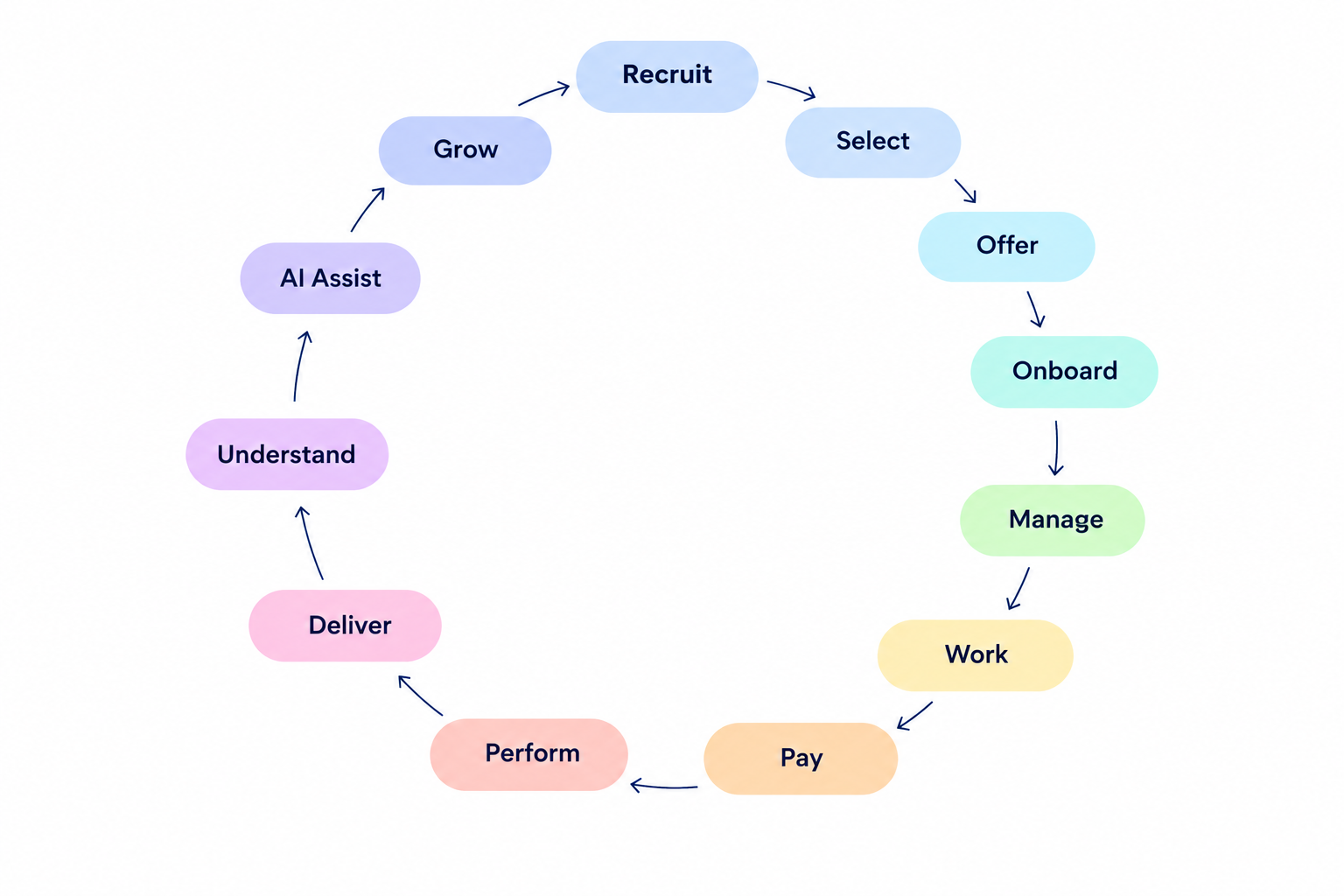
Each stage generates valuable information.
The real power comes when those stages are connected.
For example, attendance data can contribute to workforce insights. Timesheets can provide visibility into project allocation. Performance data can help managers understand employee development. Payroll can connect compensation with workforce planning.
This broader employee lifecycle approach is also reflected in HR guidance from the Society for Human Resource Management (SHRM), which describes the HR lifecycle as beginning with workforce planning and recruitment and continuing through onboarding, performance, engagement and separation.
Instead of isolated information, organizations get a connected workforce picture.
1. Recruitment: Where the Employee Journey Begins
Every employee lifecycle begins with a business requirement.
A company needs someone with the right skills, experience, and potential.
Traditionally, recruitment can involve multiple disconnected steps:
Creating job descriptions
Publishing vacancies
Receiving applications
Screening candidates
Scheduling interviews
Evaluating candidates
Selecting applicants
Sending offers
The problem starts when recruitment information remains separate from the rest of HR.
Once a candidate is hired, HR teams often have to enter the same information again into an employee management system.
That means:
More data entry. More time. More opportunities for mistakes.
With a connected HRMS approach, recruitment becomes the first stage of the employee lifecycle rather than a separate process.
Candidate information can move naturally toward the next stage—onboarding.
For organizations looking to centralize these workflows, Emmato's AI-powered HRMS brings recruitment, HR, payroll, performance and employee engagement into one platform.
The goal isn't simply to hire faster.
It is to create a smoother transition from candidate to employee.
2. Selection & Offer: Turning Candidates Into Future Employees
Recruitment doesn't end when applications arrive.
Organizations need to evaluate candidates, compare skills, conduct interviews, collect feedback, and make informed hiring decisions.
A structured HRMS can help organizations organize this information and create a more consistent selection process.
Once the candidate is selected, the next step is the offer.
This is an important transition.
The candidate is no longer simply part of a recruitment pipeline.
They are becoming part of the organization.
With connected HR processes, information such as:
Candidate details
Position
Department
Compensation
Joining information
Manager
Employment details
can become part of the employee's organizational record.
This eliminates the need to start the employee record from scratch.
3. Onboarding: The First Day Shouldn't Feel Like Paperwork
Imagine joining a company and receiving five different emails.
One asks for documents.
Another asks you to complete payroll information.
Another contains attendance instructions.
Your manager sends another message about your first project.
HR sends a spreadsheet.
This is a common onboarding experience.
But onboarding should be more than administrative paperwork.
It is the employee's first real interaction with the organization.
A modern onboarding process can bring together:
Employee information
Document collection
Department assignment
Designation
Reporting manager
Payroll information
Attendance configuration
Company policies
Joining formalities
With a connected HRMS, onboarding becomes part of the employee's broader digital journey.
Instead of asking new employees to navigate multiple systems, organizations can create a more consistent experience.
Recruitment ends. Employment begins.
Make onboarding part of a connected HR workflow
4. Employee Management: One Source of Truth
Once an employee joins, HR needs a reliable source of information.
Employee records can include:
Personal information
Employment details
Department
Designation
Manager
Documents
Joining date
Compensation information
Employment history
Organizational structure
When this information is stored across spreadsheets and separate applications, maintaining accuracy becomes difficult.
A centralized HRMS creates a single workforce record.
This becomes the foundation for other HR processes.
The same employee record can connect with:
Attendance → Leave → Payroll → Performance → Timesheets → Projects → Analytics
This is where an HRMS becomes more than an employee database.
It becomes the system of record for the workforce.
Emmato currently positions its platform around unified HR and workforce operations, with modules spanning areas such as timesheets, leave, assets, travel, clients, projects, reporting and approvals.
5. Attendance & Leave: Understanding the Everyday Workforce
Employees create workforce data every day.
They arrive at work.
They work remotely.
They visit clients.
They take leave.
They work on projects.
They log hours.
Attendance therefore isn't simply about answering:
“Who is present today?”
It can also help organizations understand workforce availability and operational patterns.
Modern HRMS platforms can support capabilities such as:
Smart attendance
Mobile check-ins
Face recognition
Geo-fencing
Remote attendance
Attendance tracking
Leave requests
Leave approvals
Attendance reports
For employees, this can make everyday HR tasks simpler.
For managers, it provides better visibility.
For HR teams, it reduces manual administration.
And for leadership, connected attendance data becomes another source of workforce intelligence.
From attendance tracking to workforce visibility
See how Emmato brings HR and workforce operations together
6. Payroll: Connecting People Data With Business Data
Payroll is one of the most important HR processes in any organization.
Employees expect their salaries to be accurate.
Finance teams need reliable information.
HR teams need to manage employee compensation and adjustments.
The challenge is that payroll depends on information from multiple areas.
For example:
Employee information + compensation + attendance + leave + adjustments = payroll data
When these systems are disconnected, HR teams may spend significant time collecting and validating information.
An integrated HRMS can bring the necessary workforce information together.
This creates a more connected payroll workflow and reduces repetitive data handling.
Instead of payroll existing as an isolated function, it becomes another part of the employee lifecycle.
For organizations evaluating broader enterprise modernization, NexGen also provides data engineering and AI capabilities designed to turn operational data into applied intelligence.
7. Performance Management: From Attendance to Contribution
An employee is more than a record in an HR database.
They have goals.
They develop skills.
They work on projects.
They solve problems.
They contribute to business outcomes.
That is why modern HRMS platforms need to go beyond attendance and payroll.
Performance management can include:
Goal setting
Goal tracking
Performance reviews
Feedback
Skill development
Training
Manager evaluations
Employee growth
This changes the HR conversation.
Instead of asking:
“Is this employee working?”
Organizations can start asking:
“How is this employee contributing, developing, and growing?”
This is an important shift from employee administration to employee development.
8. Timesheets: Connecting People With the Work They Actually Do
Here is a question traditional HR systems often cannot answer:
“Where is employee time being spent?”
An employee may be present for eight hours.
But those eight hours could be distributed across:
Client projects
Internal projects
Meetings
Development
Support
Research
Administrative work
This is where timesheets become valuable.
With timesheet management, organizations can track work hours against projects, tasks, or activities.
For project-based businesses, this can provide greater visibility into:
Project effort
Resource utilization
Employee workload
Project costs
Billable hours
Team allocation
Emmato's current platform specifically highlights weekly timesheets, project-based logging, approvals, billable/non-billable splits, totals and overtime alerts.
This connects HR with business operations.
The employee record now tells a bigger story.
Not simply:
“This person works here.”
But:
“This person works here, belongs to this team, contributes to these projects, and spends time on these activities.”
9. Project & Workforce Management: HR Meets Operations
Employees are ultimately hired to create value.
That value is often delivered through projects, customers, products, services, and internal initiatives.
This makes the connection between HR and operations increasingly important.
When HRMS data connects with work and project information, leaders can gain better visibility into workforce utilization.
For example, organizations can identify:
Which teams are overloaded
Where additional resources may be needed
Which employees have available capacity
How resources are distributed
How much time projects consume
This creates a bridge between people management and business management.
And that bridge is one of the most important developments in modern HR technology.
Organizations that need additional support connecting HR platforms with broader enterprise systems can also explore NexGen's technology and SaaS engineering capabilities, including APIs, integrations, AI integration and product modernization.
10. Employee Self-Service: HR in Your Pocket
Employees shouldn't need to contact HR for every small request.
Modern employees expect digital self-service.
They want to:
Check attendance
Apply for leave
View payroll information
Submit timesheets
Track goals
Receive notifications
Complete approvals
Access HR information
A mobile-friendly HRMS puts these capabilities closer to employees.
Instead of sending an email:
“Can you please update my leave?”
An employee can simply submit a request through the platform.
Instead of asking HR:
“Can you send me my payslip?”
The employee can access it directly.
This creates a better employee experience while reducing repetitive HR workload.
Good HR technology doesn't add another task to an employee's day. It removes one.
11. Workforce Analytics: From Data to Decisions
Every HR process generates data.
Recruitment generates candidate data.
Onboarding generates employee data.
Attendance generates workforce availability data.
Payroll generates compensation data.
Performance generates contribution data.
Timesheets generate work data.
When these datasets remain disconnected, organizations see individual pieces.
When they are connected, organizations can start seeing patterns.
This is where workforce analytics becomes powerful.
Leadership can gain insights into areas such as:
Workforce size
Attendance trends
Leave patterns
Payroll costs
Employee performance
Resource utilization
Project allocation
Workforce growth
The objective isn't to create more reports.
The objective is to help leaders make better workforce decisions.
For organizations exploring AI-driven analytics beyond HR, NexGen's AI and data engineering services can also support broader enterprise data and intelligence initiatives.
12. AI Workforce Intelligence: When HRMS Starts Thinking With You
The next evolution of HRMS is artificial intelligence.
Traditional HR software primarily stores information and executes predefined workflows.
AI can add another layer:
understanding.
Imagine an HR manager asking:
“Which departments have the highest absenteeism?”
Instead of manually exporting reports, filtering spreadsheets, and comparing numbers, an intelligent HR platform can help surface the relevant information.
AI can also support:
Intelligent HR assistance
Workforce insights
Automated workflows
Pattern identification
Data interpretation
Employee information retrieval
Decision support
The important point is that AI shouldn't replace HR professionals.
It should give them more time to do what humans do best:
lead people, solve problems, build culture, and make decisions.
This shift is becoming increasingly important in HR technology. Gartner's 2026 HR Technology Trends research notes that AI in HR is maturing and that HR leaders need to prepare for increasing business demand around emerging AI capabilities.
For organizations looking beyond HR automation toward enterprise AI, NexGen also offers Agentic AI solutions focused on production-grade agents that can plan, use tools and execute workflows with human oversight.
The Emmato HRMS Full Cycle
At this point, the individual processes connect into one larger picture:
Recruit → Select → Offer → Onboard → Manage → Work → Pay → Perform → Deliver → Understand → AI Assist → Grow
The important idea isn't simply that an HRMS has twelve stages.
It's that information created in one process can become useful in another.
Recruitment creates candidate information.
Onboarding turns that information into an employee record.
Attendance and leave add workforce activity.
Payroll adds compensation information.
Performance adds contribution and development information.
Timesheets and projects add work context.
Analytics brings the information together.
AI adds an intelligence layer.
That is the connected HRMS model.
Why a Connected HRMS Is Different
The biggest advantage of a connected HRMS isn't necessarily the number of features.
It is the relationship between those features.
Traditional approach
Recruitment → System A
Onboarding → System B
Attendance → System C
Payroll → System D
Performance → System E
Timesheets → System F
Analytics → Spreadsheets
Each system may work perfectly on its own.
But the organization still has to connect the information.
Connected approach
One employee record → multiple connected HR processes → one workforce view
That is the difference.
The value comes from the connection.
What Emmato Means for HR Teams
For HR professionals, an intelligent HRMS can reduce repetitive administrative work.
Instead of spending hours maintaining spreadsheets, HR teams can focus more on:
Employee engagement
Talent development
Workforce planning
Culture
Retention
Strategic HR initiatives
The technology handles more of the administration.
HR gets more time for the human side of human resources.
A smarter HR operation starts with connected processes.
Explore Emmato's AI-powered HRMS
What Emmato Means for Employees
Employees don't think in terms of HR modules.
They don't wake up thinking:
“Today I need to use the attendance module.”
They simply want to work.
They want to request leave.
They want to see their information.
They want to submit their timesheet.
They want to understand their goals.
They want their HR experience to be simple.
That is why a connected HRMS should feel less like a collection of software modules and more like one workplace experience.
What Emmato Means for Leadership
For business leaders, HRMS data can become a strategic asset.
Leadership needs answers to questions such as:
How quickly is our workforce growing?
Where are our resources being utilized?
What are our workforce costs?
Which teams need additional resources?
How are employees performing?
Where are workforce challenges emerging?
A connected HRMS can help transform HR data into business intelligence.
This is the shift from:
HR Administration → Workforce Intelligence
And that shift fits into the larger transformation toward AI-native enterprise operations that NexGen describes across its technology portfolio.
The Future of HRMS Is Connected, Intelligent & Human
The future of HR technology isn't simply about adding another module.
It's about creating a connected employee experience.
Recruitment should connect to onboarding.
Onboarding should connect to employee management.
Employee management should connect to attendance and payroll.
Work should connect to timesheets and projects.
Performance should connect to development.
All of that data should connect to analytics.
And analytics should become intelligent enough to help people make better decisions.
The broader HR industry is already moving in this direction. SHRM describes the HR lifecycle as a connected journey from workforce planning and recruitment through onboarding, performance, engagement and separation.
The next step is making that journey digital, connected and increasingly intelligent.
Frequently Asked Questions About HRMS
What is an HRMS full cycle?
An HRMS full cycle covers the major stages of managing employees, including recruitment, onboarding, employee management, attendance, leave, payroll, performance, timesheets, analytics and workforce development.
What is an employee lifecycle in HR?
The employee lifecycle describes the stages an employee goes through from recruitment and hiring through onboarding, employment, development, performance, engagement and eventually separation.
For a broader explanation, see SHRM's guide to the HR lifecycle.
Why is an integrated HRMS important?
An integrated HRMS connects HR processes and employee data in one environment. This can reduce duplicate data entry, improve information consistency, simplify workflows, and provide leadership with a more complete workforce view.
How does AI improve HRMS?
AI can help HR teams analyze workforce information, automate repetitive activities, retrieve information faster, identify patterns, and support data-driven decision-making.
Can HRMS manage attendance and payroll together?
An integrated HRMS can connect attendance, leave, employee information, compensation and payroll workflows so that workforce information can move between processes more efficiently.
What is workforce intelligence?
Workforce intelligence refers to using employee and organizational data to understand workforce trends, resource utilization, performance, costs and other factors that support better business decisions.
Conclusion: One Workforce. One Connected HRMS.
HR has changed.
Employees have changed.
Businesses have changed.
And HR technology needs to change with them.
The future isn't a collection of disconnected HR tools.
It is a connected ecosystem where employee information, HR processes, workforce activity and business data can work together.
From recruitment to onboarding.
From attendance to payroll.
From projects to performance.
From data to intelligence.
From intelligence to growth.
Emmato connects the journey.
Because HR should not have to manage disconnected processes.
Employees shouldn't have to navigate fragmented HR experiences.
And leaders shouldn't have to piece together workforce intelligence from multiple reports.
Emmato
One Intelligent HRMS for the Complete Employee Lifecycle.
Recruit. Manage. Work. Perform. Understand. Grow.
Ready to Make HR Smarter?
Your HR team shouldn't have to switch between spreadsheets, emails and disconnected systems just to manage one employee.
With Emmato's unified HRMS platform, organizations can bring recruitment, HR, payroll, performance and employee engagement into one connected environment.
Start with a smarter HR workflow.
Don't just digitize HR.