The Future of SMBs: Why One Connected Platform Beats 10 Disconnected Tools
AI-Powered Business Management | SMB Growth | Digital Transformation
 Shiksha SaraswatSr. Digital Marketing AnalystSep 4, 202610 min readNexGen NGSBS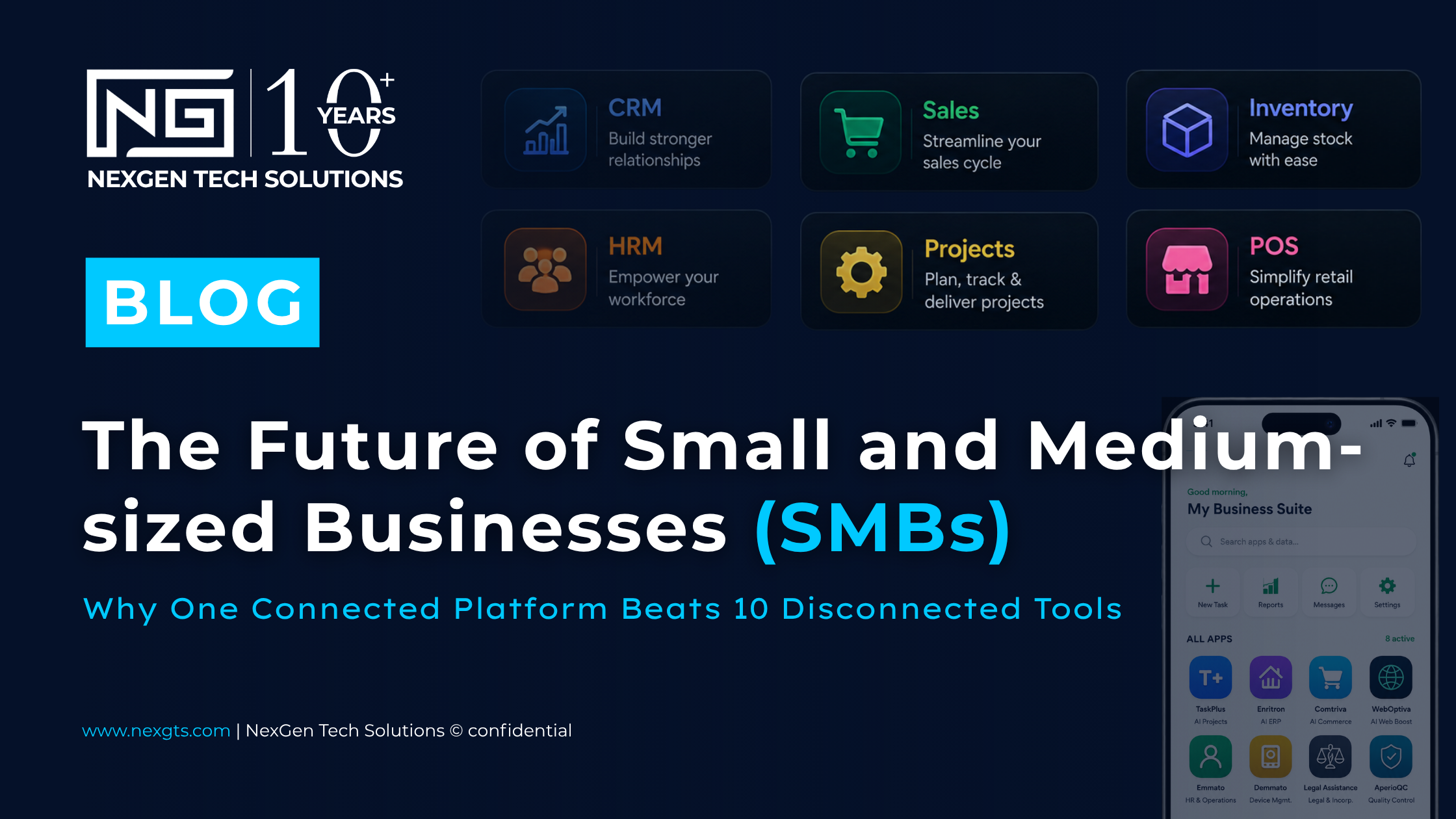
Running a small or medium-sized business in 2026 is more digital than ever.
But being digital doesn't always mean being connected.
Businesses increasingly rely on separate tools for CRM, accounting, HR, payroll, inventory, e-commerce, project management, websites, analytics, cybersecurity, and device management.
Each application may solve a specific problem. But as the technology stack grows, so does the complexity.
More logins.
More subscriptions.
More integrations.
More spreadsheets.
More duplicated data.
More time spent moving information between systems.
This is tool sprawl.
For growing SMBs, tool sprawl can become an operational challenge that affects productivity, visibility, costs, and scalability.
The question is no longer:
"Which app should we add next?"
The better question is:
"How can we make our business systems work together?"
That's where a connected business platform can make a difference.
Technology should make business easier. But disconnected systems can sometimes create the opposite effect.
1. Too Many Business Tools
Businesses can quickly accumulate applications for individual functions.
Sales uses one system.
Finance uses another.
HR has its own platform.
Operations may depend on spreadsheets.
Marketing uses several more tools.
Customer information may exist in a CRM while financial information sits somewhere else.
The result is a technology environment where important information is distributed across multiple systems.
The problem isn't necessarily having multiple applications.
The problem is when those applications don't work together.
2. Manual Workflows
When systems don't communicate, employees often become the connection between them.
Data gets exported, copied, uploaded, checked, and reconciled manually.
For example:
Order → Spreadsheet → Inventory → Accounting → Report
Every manual handoff creates additional work.
It can also create opportunities for:
- Data-entry mistakes
- Duplicate records
- Delayed updates
- Missing information
- Reporting inconsistencies
Automation can help businesses reduce these repetitive processes and allow employees to focus on higher-value work.
3. Disconnected Business Insights
A dashboard can tell you what happened.
But understanding why it happened can require information from multiple systems.
Imagine that revenue falls during a particular month.
Was the reason:
- Lower customer demand?
- Inventory shortages?
- Website performance?
- Customer churn?
- Pricing changes?
- Delayed fulfillment?
- Product availability?
If the relevant information exists across different systems, finding the complete picture can take time.
Connected business data creates the foundation for more contextual analysis.
4. Scaling Becomes More Complicated
The systems that work for a small team may become difficult to manage as the company grows.
More employees mean more users.
More customers mean more transactions.
More locations mean more operational complexity.
More devices mean more management requirements.
More data means more reporting requirements.
Growth shouldn't require businesses to continuously rebuild their technology environment.
A scalable technology foundation should grow alongside the business.
A connected business platform brings multiple business capabilities together within an integrated digital ecosystem.
Instead of treating finance, sales, HR, projects, commerce, operations, and technology as completely isolated functions, a connected platform allows relevant information and workflows to move between them.
The objective is to create a single source of business information.
For example:
Customer → Sales → Order → Inventory → Finance → Analytics
Instead of repeatedly entering the same information into different systems, connected workflows can help information move through the organization more efficiently.
This is the fundamental idea behind NGSMBS.
A connected platform isn't about having fewer applications simply for the sake of having fewer applications.
It's about reducing unnecessary complexity.
One Source of Truth
When important business data is distributed across different systems, teams can end up working with different versions of the same information.
A connected environment can help teams work from consistent business data.
Sales can see customer information.
Finance can see transactions.
Operations can see orders and inventory.
Management can see broader business performance.
Fewer Manual Handoffs
Connected workflows can reduce the need to repeatedly transfer information between systems.
Instead of:
Export → Download → Edit → Upload → Reconcile
business processes can move toward:
Capture → Connect → Automate → Analyze
This can save time and reduce repetitive administrative work.
Better Visibility
Business leaders need more than individual reports.
They need to understand how different parts of the business affect one another.
Connected systems can make it easier to look across:
Revenue + Customers + Inventory + Finance + People + Projects + Operations
This broader context can support faster and better-informed decisions.
Artificial intelligence is becoming an increasingly important part of modern business software.
But AI becomes more valuable when it has access to relevant context.
Consider a business owner asking:
"Why did our revenue decline this month?"
A traditional dashboard may show the decline.
A connected AI-powered environment can potentially help investigate the factors behind it.
For example:
- Inventory availability
- Customer activity
- Website performance
- Sales pipeline
- Product performance
- Order fulfillment
- Customer retention
The same concept can apply to project management.
A manager could ask:
"Which projects are at risk of missing their deadlines?"
Or to sales:
"Which customers are most likely to purchase again?"
Or to operations:
"Which processes are taking the most time?"
This represents a shift from simple reporting toward AI-assisted business intelligence and decision support.
Businesses can also explore responsible AI practices and risk management through resources such as the NIST AI Risk Management Framework.
NexGen Small Business Suite (NGSMBS) is designed around the idea of bringing important business capabilities together within one connected ecosystem.
Rather than requiring SMBs to build an increasingly complex collection of unrelated applications, NGSMBS brings together multiple solutions for different business needs.
TaskPlus AI Projects
TaskPlus helps businesses manage projects, tasks, documentation, collaboration, and AI-assisted workflows.
Instead of managing project information across disconnected documents and applications, teams can work within a more unified environment.
Enritron ERP
Enritron ERP focuses on core business operations including finance and inventory.
Connecting financial and operational information can provide businesses with greater visibility into the relationship between transactions, inventory, and overall performance.
Comtriva Commerce
Comtriva Commerce supports modern e-commerce operations across digital channels.
For businesses selling online, connecting commerce with inventory and financial operations can help create a smoother flow from customer order to business reporting.
WebOptiva
WebOptiva focuses on website performance, SEO, speed, security, and digital visibility.
A business website is often an important part of the customer journey, making website performance and discoverability important components of digital growth.
Emmato HR & Operations
Emmato brings HR and operational workflows together to help businesses manage people and processes more efficiently.
Connecting workforce information with broader business operations can provide organizations with better visibility as they scale.
Demmato Device Management
Modern businesses depend on laptops, desktops, mobile devices, and other connected endpoints.
Demmato provides centralized device management capabilities to help businesses maintain visibility and control over their technology environment.
For cybersecurity guidance specifically aimed at small and medium-sized organizations, businesses can also refer to CISA's Small and Medium Business Resources.
HRMS People
Workforce management becomes increasingly important as organizations grow.
HRMS People supports employee and workforce-related processes, helping businesses organize and manage their people operations.
Legal Assistance
Growing businesses may also need support with incorporation, immigration, and compliance-related requirements.
NGSMBS provides access to legal assistance capabilities designed to support businesses across supported markets.
The value of connected software becomes clearer when we look at practical business scenarios.
Retail & E-commerce
A retail business may need commerce, inventory, finance, and website optimization.
A connected environment can bring together:
Comtriva + Enritron + WebOptiva
The objective is to create a smoother connection between the customer's digital experience and the company's internal operations.
Professional Services
A consulting, agency, or professional services company may need project management, workforce management, and finance.
A possible combination is:
TaskPlus + Emmato + Enritron
This can help connect project delivery, people, and financial operations.
Manufacturing
A manufacturing company may need ERP, inventory, workforce management, and technology management.
A possible combination is:
Enritron + HRMS + Demmato
This brings together core operations, people, and business devices.
Startups
Startups don't necessarily need every business capability on day one.
They can begin with the areas that matter most and expand as the company grows.
This modular approach allows businesses to adopt technology based on actual requirements rather than purchasing a complicated technology stack before they need it.
The cost of disconnected software isn't limited to subscription fees.
There are several other costs businesses need to consider.
Time
Employees may spend hours moving information between systems.
Errors
Manual data entry can create mistakes and inconsistencies.
Training
Every application requires employees to learn another interface.
Integration
Different platforms may require APIs, connectors, or custom integrations.
Administration
Users, permissions, subscriptions, integrations, and security settings all require management.
Decision Delays
When information is fragmented, leaders may spend more time collecting information than acting on it.
This means the real cost of software isn't simply:
"How much does this application cost?"
It is also:
"How much complexity does this application create?"
Businesses don't necessarily need to replace every application immediately.
A practical approach is to start with the areas creating the most operational friction.
Step 1: Audit Your Current Tools
Create a list of every application your business uses.
Identify:
- What it does
- Who uses it
- What data it stores
- What it costs
- What other systems it connects to
Step 2: Identify Duplicate Capabilities
You may discover that several tools perform overlapping functions.
For example, multiple applications may provide:
- Task management
- Customer records
- Reporting
- Communication
- File storage
Look for opportunities to consolidate.
Step 3: Identify Manual Handoffs
Find the processes where employees repeatedly copy or reconcile information.
These are strong candidates for automation.
Step 4: Prioritize Integration
Focus first on systems that have the greatest impact on revenue, customers, finance, or operations.
Step 5: Introduce AI Carefully
AI should solve real business problems rather than being added simply because it is trending.
Start with practical use cases such as:
- Search
- Summarization
- Reporting
- Recommendations
- Workflow automation
- Data analysis
Step 6: Build for Growth
Choose technology that can support your current requirements while giving you room to expand.
A connected business platform can provide a stronger digital foundation for growing organizations.
Connected Data
Relevant business information can move between processes without unnecessary duplication.
Automation
Routine workflows can be automated to reduce repetitive administrative work.
Visibility
Leadership teams can gain a broader view of business operations.
AI Assistance
AI can help analyze information, identify patterns, and support decision-making.
Scalability
Businesses can add capabilities as their operations grow.
Simplified Technology Management
Reducing unnecessary fragmentation can make the technology environment easier to understand and manage.
The next generation of business software isn't simply about adding more applications.
It's about creating connected digital operations.
Businesses will increasingly expect their technology to:
- Share information automatically
- Reduce repetitive work
- Provide real-time visibility
- Understand business context
- Automate routine processes
- Surface useful insights
- Support employees
- Scale with business growth
AI will increasingly become an intelligence layer across these processes.
This doesn't mean every business needs to automate everything.
It means businesses should identify where technology can remove friction and create better outcomes.
SMBs don't need more apps just for the sake of having more apps.
They need technology that works together.
They need data that can move across the business.
They need automation that eliminates unnecessary manual work.
And they need AI that can understand the context behind their operations.
That's the vision behind NexGen Small Business Suite (NGSMBS):
One connected business ecosystem for modern SMBs.
Bring together people, projects, finance, commerce, operations, websites, devices, and AI and create a technology environment designed not just to run your business, but to help it grow.
What is a connected business platform?
A connected business platform brings multiple business functions and workflows into an integrated environment, helping organizations share information and reduce unnecessary manual processes.
Why should SMBs consider a connected platform?
SMBs can benefit from reduced tool complexity, better visibility, fewer manual workflows, improved data consistency, and a technology foundation that can scale with the business.
Does a connected platform mean replacing every existing application?
Not necessarily. Businesses can take a modular approach and prioritize the systems and processes that provide the greatest value.
How does AI help a connected business platform?
AI can use connected business context to assist with analysis, automation, recommendations, search, reporting, and decision support.
Is NGSMBS suitable for growing businesses?
NGSMBS is designed for SMBs that want to bring multiple business functions into a connected ecosystem and expand their capabilities as their requirements grow.
Your business shouldn't need dozens of disconnected systems to operate effectively.
Build a more connected foundation for your people, operations, finance, commerce, projects, websites, devices, and AI.