Your Team Doesn’t Need More AI Tools. It Needs One Place Where Work Gets Done.
AI-Powered Work Management for Teams That Want Less Chaos and More Execution
 Satender SharmaFounder & Global CEO Sep 9, 20266 min readTaskPlus
Your team probably doesn’t have a productivity problem.
It has a work visibility problem.
Tasks live in one application. Conversations happen somewhere else. Project updates sit in spreadsheets. Approvals get buried in email. Documents are scattered across drives. And managers spend more time asking “What’s the status?” than actually helping their teams move work forward.
This is the hidden cost of modern work:
More tools can create less clarity.
That’s where an AI work management platform like Taskplus+ changes the model.
Instead of adding another disconnected tool, Task+ creates a connected execution layer where people, tasks, projects, priorities, workflows, communication, data, and AI work together.
The Hidden Cost of “More Tools”
Enterprise teams use dozens of applications every day.
Microsoft Teams for communication.
Slack for conversations.
Outlook for email.
Excel for tracking.
Google Drive for documents.
Jira for development.
Each application has a purpose.
The problem begins when the work itself moves between them.
A manager may know that a task exists, but still have no immediate answer to:
- Who owns it?
- Is it a priority?
- What project does it affect?
- Is someone waiting on another person?
- Is the deadline at risk?
- What should happen next?
- Which work is currently blocking the team?
The result is context switching, duplicated updates, missed deadlines, and constant follow-up.
The modern workplace has become connected at the communication level—but often disconnected at the execution level.
Task+ was built around a simple idea:
Managing work shouldn't mean searching for work.
Instead of forcing teams to jump between systems to understand what is happening, Task+ brings the important pieces of execution together.
People + Tasks + Projects + Priorities + Workflows + Communication + Data + AI
All connected inside one intelligent workspace.
This creates a different approach to work management.
Traditional platforms primarily help teams record and organize work.
Task+ is designed to help teams understand, prioritize, and execute work.
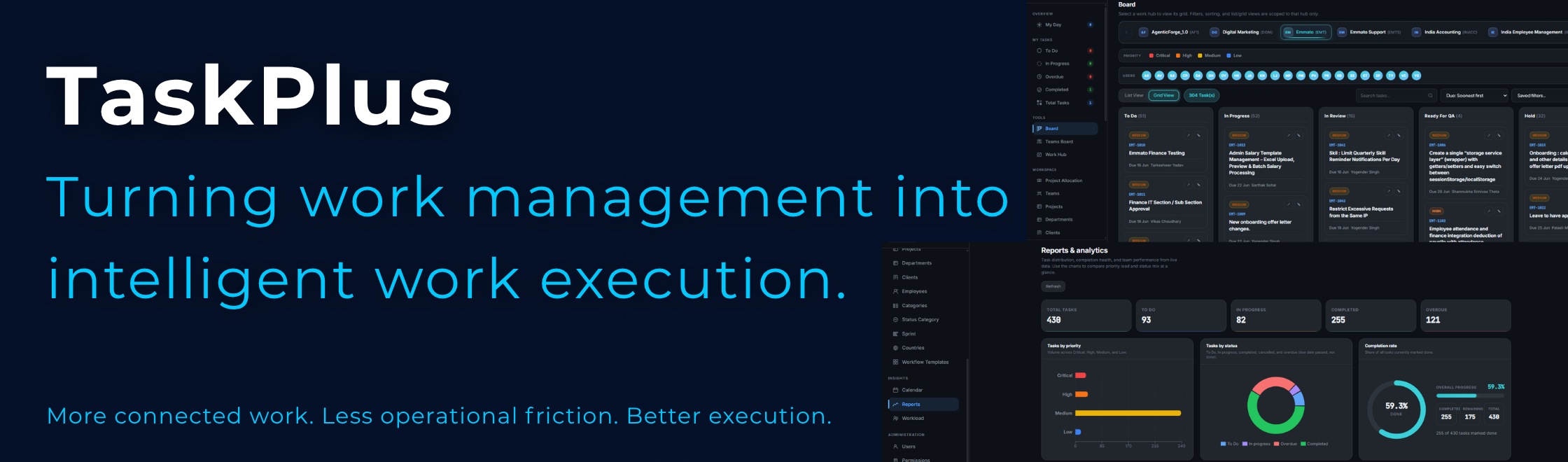
At the center of Task+ is a simple, visual representation of work.
To Do
Work that needs attention.
In Progress
Work currently being executed.
Done
Work that has been completed.
But a modern work board needs more than three columns.
Every task can carry the context required to understand its importance:
- Owner
- Priority
- Project
- Due date
- Dependencies
- Work hub
- Workflow context
That turns a basic Kanban board into something much more useful:
A work intelligence interface.
Instead of simply showing what exists, the workspace can help teams understand what matters.
Imagine a marketing team with 50 active tasks.
A conventional task list may show all 50.
But a manager doesn't necessarily need to look at all 50.
They need to know:
Which five could affect this week's delivery?
For example:
- A campaign is blocked by an approval.
- A landing page deadline is approaching.
- One team member has significantly more work than others.
- A critical dependency hasn't been completed.
- An important task is already overdue.
This is where AI can move work management beyond simple task tracking.
Instead of making managers search through information, the platform can surface the information that deserves attention.
AI becomes significantly more valuable when it is connected to the actual work being performed.
Task+ brings intelligence directly into the execution environment.
Execution Insights
Identify tasks that could potentially affect upcoming delivery.
Example:
“3 tasks may derail this week's delivery.”
Bottleneck Detection
Identify work that is preventing other work from moving forward.
Example:
“Design approval is blocking 2 dependent tasks.”
Priority Recommendations
Help teams identify which work should receive attention first.
Example:
“Consider moving Landing Page to high priority due to the approaching deadline.”
Workload Visibility
Identify uneven task distribution across team members.
Example:
“One team member has 14 active tasks while another has 4.”
Deadline Risk
Highlight projects where current progress could create delivery risk.
The objective isn't to replace managers.
It's to give them better visibility before problems become bigger problems.
Different markets have different operational challenges, but the underlying problem is often the same:
How do you make more work happen without creating more operational complexity?
India: Scale Without Adding Complexity
Indian businesses are managing increasingly distributed teams, multiple clients, projects, and delivery timelines.
For agencies, IT companies, consulting firms, startups, and growing enterprises, the challenge isn't simply creating tasks.
It's coordinating hundreds of moving pieces.
An AI work management platform can help teams move from:
Manual follow-up → Connected execution
The goal is simple:
Scale work without scaling administrative overhead.
Businesses operating in Dubai and the wider UAE often work across departments, clients, projects, and rapidly changing priorities.
When work moves quickly, visibility becomes critical.
Teams need to know:
- What is happening?
- Who owns it?
- What's delayed?
- What's blocking progress?
- What needs attention now?
AI-powered work management can provide a centralized execution layer that helps teams maintain visibility while moving quickly.
The opportunity isn't simply to add AI.
It's to embed intelligence into everyday business operations.
Many organizations are moving beyond experimenting with AI and looking for practical ways to integrate AI into daily workflows.
That means asking a different question.
Not:
“Where can we use AI?”
But:
“Where can AI help our people execute better?”
Work management is one of those areas.
Tasks already contain valuable operational information:
- deadlines
- ownership
- dependencies
- priorities
- project relationships
- completion status
When AI can work with that context, it can become more useful than a standalone chatbot.
It becomes an execution assistant.
For current Canadian business AI adoption data, see the latest Statistics Canada analysis on artificial intelligence use by businesses.
Calling Task+ simply a “task manager” misses the bigger picture.
Task+ is positioned as an AI-powered work execution platform.
Think of the platform in five layers:
1. Work
Tasks and projects.
2. Organization
Teams, people, and work hubs.
3. Execution
Priorities, workflows, dependencies, and deadlines.
4. Visibility
Boards, dashboards, and centralized work information.
5. Intelligence
AI-powered insights, recommendations, risk detection, and execution support.
Together, these layers create something more valuable than another task list.
A connected system for getting work done.
Traditional work management often follows this model:
Create → Assign → Track → Complete
But intelligent work management can go further:
Create → Understand → Prioritize → Execute → Predict → Automate → Improve
That difference is important.
Because productivity isn't just about completing more tasks.
It's about completing the right work at the right time with the right context.
Task+ isn't trying to win by adding another hundred features to the productivity stack.
Its opportunity is different.
While platforms such as ClickUp, Asana, monday.com and Atlassian have established powerful approaches to project and work management, Task+ can differentiate around a more focused idea:
Execution intelligence.
The progression becomes:
Tasks → People → Projects → Workflows → AI → Execution
Everything is connected.
And when everything is connected, teams don't have to spend their day reconstructing what is happening.
They can spend more time making it happen.
The next generation of productivity isn't necessarily about giving employees another application.
It's about reducing the number of places they need to look.
The best AI work management platform should help answer questions before managers have to ask them:
What's important?
What's blocked?
Who's overloaded?
What's at risk?
What should happen next?
That's the shift from work tracking to work intelligence.
Your team doesn't need another AI tool sitting beside the tools they already use.
It needs a place where work can come together.
Task+ connects tasks, teams, projects, priorities, workflows, and AI-powered execution inside one intelligent workspace.
The future of productivity isn't:
More tools.
Explore TaskPlus AI | Visit our website
Book a Demo | — Email us to schedule your TaskPlus AI demo.
Contact Us | E-mail:sales@nexgts.com , Call: +1 (416) 953-7900