
Generative Engine Optimization (GEO): Transforming Enterprise Visibility for the AI Search Era
Discover how a GEO strategy improved AI search visibility, SEO performance, Core Web Vitals, and enterprise website readiness for AI search.
Executive Summary
As AI-powered search experiences
become a primary channel for research and decision-making, enterprises face a
new challenge: maintaining visibility not only in traditional search results
but also in AI-generated recommendations.
This case study illustrates how
an enterprise website can transition from strong traditional SEO performance to
comprehensive AI-search readiness through a combination of structured data
optimization, semantic content improvements, website performance enhancements,
and continuous monitoring. Using WebOptiva's unified website intelligence
platform, organizations can identify and close critical gaps that impact
visibility across ChatGPT, Google AI Overviews, Gemini,
Claude, and
Perplexity.
Industry
Retail & E-Commerce (Applicable Across Industries)
A mid-market direct-to-consumer
retailer with approximately 40,000 monthly organic visitors had invested
heavily in traditional search engine optimization and consistently achieved
first-page rankings for several high-value keywords.
Despite strong SEO performance,
the company's marketing team discovered that its brand and products were rarely
referenced when users asked AI assistants for purchasing recommendations or
category-specific advice.
The organization faced several
key challenges:
●
Minimal visibility in AI-powered search experiences.
●
Weak machine-readable entity signals across the
website.
●
Limited structured data implementation.
●
Inconsistent Core Web Vitals performance.
●
Accessibility compliance gaps.
●
Multiple disconnected tools for SEO, performance, and
monitoring.
●
Lack of insight into AI-search readiness and GEO
performance.
As customer discovery increasingly shifted toward
conversational AI experiences, the company recognized the risk of becoming
invisible during critical buying journeys.
The organization established
five primary objectives:
●
Improve AI-search visibility and recommendation
potential.
●
Strengthen website entity recognition and authority
signals.
●
Enhance website performance and Core Web
Vitals.
●
Improve content relevance for conversational search
queries.
●
Consolidate SEO, performance, accessibility, security,
and AI-search monitoring into a unified platform.
A comprehensive WebOptiva
audit analyzed more than 300 website signals across performance, SEO,
accessibility, security, and AI-search readiness.
Key Findings
AI Search Readiness
●
Limited entity optimization.
●
Missing FAQ, Product, and Organization schema.
●
Weak semantic coverage for buyer questions.
●
Low confidence signals for AI-generated
recommendations.
Technical SEO
●
Duplicate metadata patterns.
●
Inconsistent internal linking structure.
●
Crawl efficiency opportunities.
Website Performance
●
Large unoptimized hero images.
●
High Largest Contentful Paint (LCP) scores.
●
Inconsistent mobile performance.
Accessibility
●
Missing image alt attributes.
●
Color contrast issues.
●
Limited accessibility compliance coverage.
Monitoring & Reporting
●
Three separate platforms required to generate
performance reports.
●
Manual reporting consumed significant marketing
resources.
WebOptiva was deployed as a centralized
website intelligence and optimization platform.
Phase 1: AI Search & GEO Optimization
The first priority was improving
machine understanding of the business and its offerings.
Key initiatives included:
●
Enhanced Organization schema implementation.
●
Product and category structured data deployment.
●
FAQ schema expansion.
●
Entity optimization across key landing pages.
●
Improved author and expertise attribution signals.
●
Strengthened E-E-A-T indicators throughout the website.
This enabled AI systems to better understand, interpret, and
potentially reference website content.
Phase 2: Semantic Content Enhancement
Content strategy was
restructured around user intent and conversational discovery patterns.
Content was expanded to address
common buyer questions, including:
●
Best products for specific use cases.
●
Product comparison topics.
●
Category education content.
●
Purchase decision guidance.
The focus shifted from keyword targeting alone to providing
comprehensive answers aligned with how users interact with AI assistants.
Phase 3: Performance Optimization
Website performance improvements
included:
●
Adaptive image compression.
●
Smart caching implementation.
●
Asset delivery optimization.
●
Frontend performance enhancements.
●
Continuous Core Web Vitals monitoring.
These improvements created a faster and more reliable user
experience while strengthening search and AI-readiness signals.
Phase 4: Centralized Intelligence & Monitoring
WebOptiva unified:
●
Technical SEO monitoring.
●
GEO readiness scoring.
●
Core Web Vitals tracking.
●
Accessibility assessments.
●
Website security monitoring.
●
Executive-level reporting.
Teams gained a single source of truth for website health and
optimization priorities.
Results
AI Search Visibility
●
AI readiness improved from a low-confidence state to a
strong AI-search-ready profile.
●
Structured content significantly increased machine
readability and discoverability.
●
Improved alignment with AI-generated answer ecosystems.
Website Performance
●
Core Web Vitals moved from inconsistent
performance to recommended thresholds.
●
Faster page rendering improved user experience across
key landing pages.
SEO & Content Quality
●
Stronger semantic coverage across important
buying-stage topics.
●
Improved content depth and topical authority.
●
Enhanced internal linking and content discoverability.
Accessibility & Compliance
●
Accessibility scores improved through
remediation of critical issues.
●
Greater inclusivity and usability across devices and
audiences.
Operational Efficiency
●
Reporting processes that previously required multiple
tools and manual effort were consolidated into a single automated workflow.
●
Marketing teams gained faster access to actionable
insights and optimization opportunities.
The engagement demonstrated that
traditional SEO alone is no longer sufficient in an AI-first search
environment.
Organizations that optimize for
both search engines and AI assistants are better positioned to:
●
Increase brand discoverability.
●
Improve recommendation potential in AI-generated
responses.
●
Strengthen authority and trust signals.
●
Deliver better user experiences.
● Reduce operational complexity through unified monitoring.
Key Takeaways
Challenge
Strong Google rankings did not
translate into strong AI-search visibility.
Solution
A comprehensive GEO strategy
combining structured data, entity optimization, semantic content improvements,
performance enhancements, and continuous monitoring.
Outcome
Improved AI-search readiness,
stronger website health metrics, enhanced user experience, and greater
preparedness for the future of search.
About WebOptiva
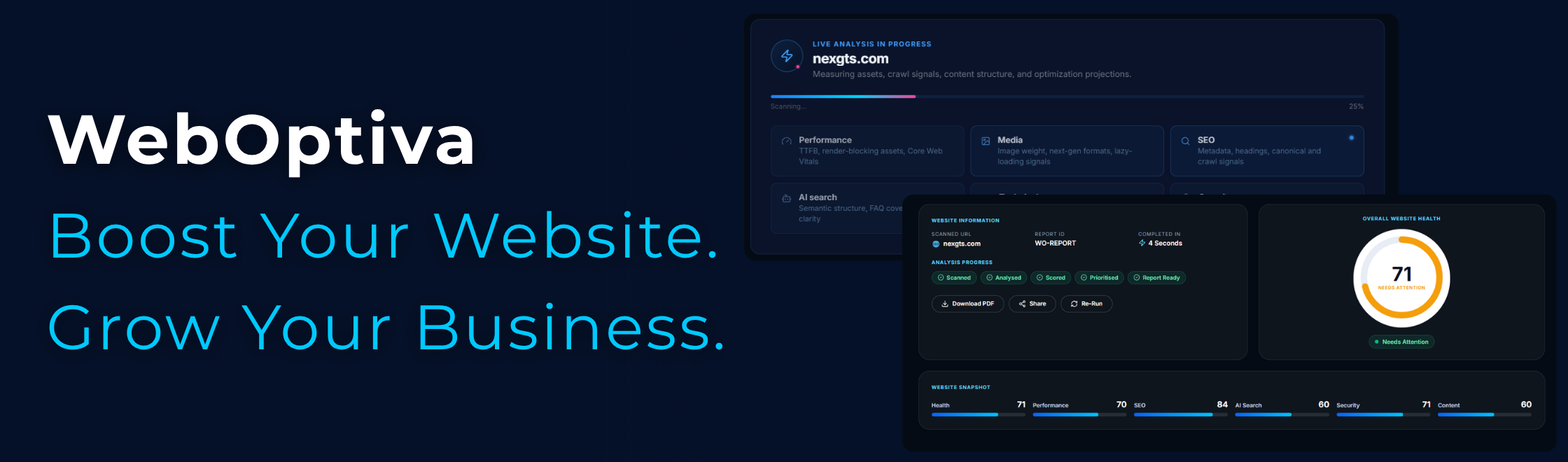
WebOptiva is an AI-powered website
intelligence platform from NexGen Tech Solutions that helps enterprises
optimize performance, security, accessibility, SEO, and Generative Engine
Optimization (GEO) from a single unified platform. By analyzing hundreds of
website signals in seconds, WebOptiva enables organizations to identify
gaps, prioritize improvements, and build visibility across both traditional
search engines and modern AI-powered search experiences.